I build medical AI that knows what it doesn't know.
Specialized in Evidential Deep Learning, Uncertainty Quantification, and Knowledge Distillation for trustworthy clinical diagnosis in resource-constrained environments.
Calibrating 3D Evidential Point Mesh...



Hi, I'm Abdullah Rubab
Undergraduate AI Researcher • Systems Builder • Medical AI Explorer
Building AI Doctors Can Actually Trust
I am a final-year Computer Science & Engineering student at Daffodil International University (DIU), a Research Associate at the NanoBio Technology Center (NBTC) under Dr. Md. Ali Hossain, and an active member of the Health Informatics Research Laboratory (HIRL).
My passion is solving real-world medical safety problems. Most standard AI models are dangerously overconfident—they will make a 99% confident guess even when handed a corrupted scan, a rare disease, or a low-quality image. My research focuses on giving medical AI models self-awareness, so they know their own limits and automatically flag uncertain cases for human doctors to review.
From Competitive Coding to Large-Scale GPU Systems
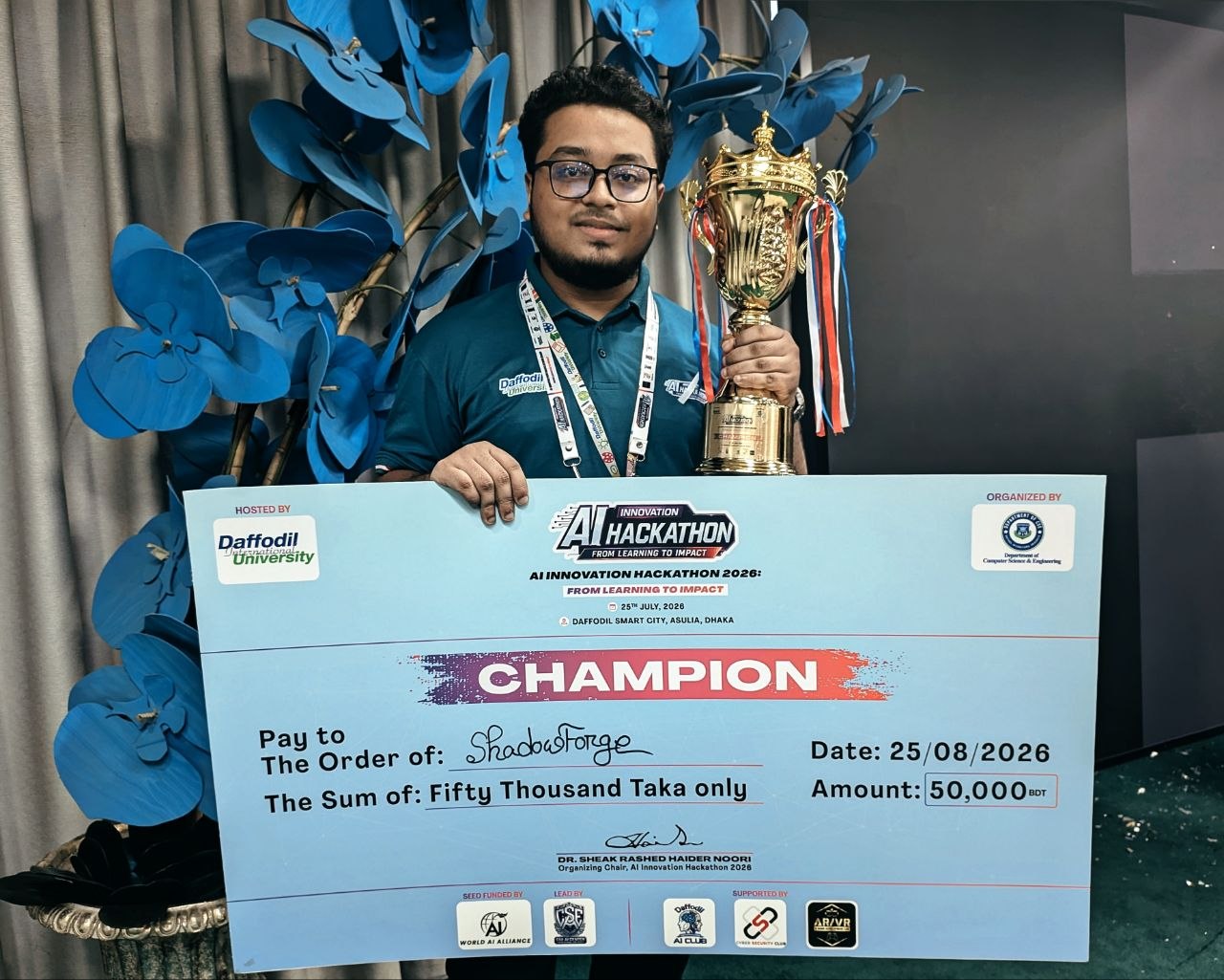
My journey started with competitive problem-solving in national programming contests and hackathons. In 2026, our team won 1st Place Champion at the DIU AI Innovation Hackathon with AURA-Cluster, a system that predicts GPU server crashes before they happen.
I also love building real infrastructure. As the Team Lead & AI/ML Backend Developer for the DIU GPU Cluster initiative, I designed the software platform that pools university lab computers into a shared computing cloud for faculty and student AI researchers.
Academic Overview
The Quest for Calibrated Confidence in Medical AI
Standard deep learning models suffer from silent overconfidence—generating 99% confident diagnostic predictions even on corrupt inputs or rare pathologies. My research equips models with epistemic self-awareness, ensuring they autonomously recognize their uncertainty and trigger specialist triage.
Silent Misdiagnosis on Out-of-Distribution Scans
Standard cross-entropy forces neural networks to arbitrarily divide 100% probability across known classes, generating confident false positives on scanner artifacts or novel pathological mutations.
Epistemic Vacuity & Autonomous Clinical Triage
By parameterizing Dirichlet priors over belief space, networks compute total evidence S and explicit epistemic vacuity u = K/S, routing uncertain scans to senior clinicians.
Uncertainty-Governed Clinical Triage Cascade
Simulate how Dirichlet prior parameterization enables models to compute epistemic vacuity \(u = K/S\) and reject ambiguous scans to secondary human specialist consultation.
Synthetic Clinical Case Queue & Dirichlet Evidence Allocation
Gastrointestinal Lesion A
Evidence \(S = 42.5\) | Vacuity \(u = 0.07\)
Blood Cell (Eosinophil)
Evidence \(S = 38.1\) | Vacuity \(u = 0.08\)
High-Grade Glioma
Evidence \(S = 51.2\) | Vacuity \(u = 0.05\)
Atypical Tissue Infiltration
Evidence \(S = 6.2\) | Vacuity \(u = 0.65\)
Artifact / Low SNR Scan
Evidence \(S = 3.8\) | Vacuity \(u = 0.82\)
Meningioma Margin
Evidence \(S = 29.4\) | Vacuity \(u = 0.12\)
Rare Polyp Mutation
Evidence \(S = 5.1\) | Vacuity \(u = 0.74\)
Pituitary Microadenoma
Evidence \(S = 34\) | Vacuity \(u = 0.09\)
Clinical Safety Impact
Standard deep learning models produce overconfident false positives on rare pathologies. Evidential deep learning prevents this catastrophic failure mode in resource-limited clinics.
Methodological Disciplines
Our medical AI investigations are anchored in four core mathematical disciplines engineered to guarantee clinical reliability, single-pass inference speed, and privacy.
Evidential Deep Learning
Dirichlet prior parameterization for single-pass epistemic uncertainty estimation.
Theoretical Foundation
Standard softmax classifiers are notoriously overconfident on out-of-distribution clinical samples. We place Dirichlet distributions over class probabilities to explicitly compute epistemic vacuity and dissonance, enabling safe, autonomous triage.
Mathematical Loss Head Formulation
Key Methodological Innovations
- Formulated Dirichlet loss heads for Vision Transformers and CNNs.
- Uncertainty-governed triage cascades rejecting ambiguous samples to human specialists.
- Zero-latency single-pass inference suitable for resource-constrained edge clinical hardware.
Implemented In Manuscripts
Research Publications Track Record
7 peer-reviewed and target manuscripts spanning Evidential Deep Learning, Vision Transformers, and Knowledge Distillation.
Sample-Efficient Fine-Grained Classification of Cactus Species Using Hybrid Vision Transformers and Knowledge Distillation
Authors: A. Rubab, M. T. Hasan (First Author & Lead Method Architect)
Explainable Multi-Scale Knowledge Distillation with Uncertainty-Aware Inference for Efficient Brain Tumor MRI Classification
Authors: Abdullah Rubab, Co-Authors (Lead Researcher & First Author)
An Efficient Attention-Guided Deep Learning Framework with Explainability for Blood Cell Classification
Authors: Abdullah Rubab, Co-Authors (Primary Author & Model Designer)
RAM-ViT: Retrieval-Augmented Evidential Vision Transformer for Cross-Modal Glioma Grading
Authors: Abdullah Rubab, NBTC Research Team (Principal Investigator & Pipeline Architect)
PUMA-MIL / PUMA-MIL-Lite: Multimodal Multiple Instance Learning for Glioma Detection with Clinical Interpretability
Authors: Abdullah Rubab, NBTC Research Group (Lead Algorithm Designer)
MSEA-Net: Multi-Scale Evidential Attention Network with Uncertainty-Governed Triage for Trustworthy Gastrointestinal Endoscopy Classification
Authors: Abdullah Rubab, Research Collaborators (Lead Researcher & Theoretical Formulator)
HCC-TACE-Seg: Foundation Model Feature Distillation for Transarterial Chemoembolization Response Prediction
Authors: Abdullah Rubab, Clinical Collaborators (Machine Learning Lead)
Flagship Medical AI & Distributed Systems
Translating theoretical uncertainty formulations into production-grade clinical pipelines, multi-agent frameworks, and high-performance GPU infrastructure platforms.
HealthSentinel AI
Federated Tri-Modal Diagnostic Platform for Low-Resource Healthcare
A decentralized medical diagnostic platform orchestrating clinical notes, imaging, and tabular vitals under strict differential privacy guarantees.
AI-Powered Brain Tumor MRI Classification
Multi-Scale Ensemble with Clinician-Facing Explainability
Production-ready PyTorch neuro-oncology pipeline with Grad-CAM visual heatmaps, uncertainty bounds, and automated radiological reporting.
AURA-Cluster
Evidential AI for Proactive GPU Failure Prediction — Hackathon Winner
Real-time telemetry forecasting system for distributed deep learning clusters using evidential neural networks. Won 1st Place at DIU AI Innovation Hackathon 2026.
DIU Distributed AI Infrastructure Platform
Campus-Wide GPU Pooling & High-Performance Compute Orchestration
Team Lead & AI/ML Backend Developer for the initiative connecting and pooling DIU's campus GPU resources into an elastic compute cloud.
ResearchForge-AI
Multi-Agent System for High-Impact Q1 Academic Workflows
Autonomous multi-agent orchestration framework for literature synthesis, mathematical formalization verification, and experiment tracking.
Institutional Research & Distributed AI Platforms
Leading high-performance GPU infrastructure initiatives, computational medical AI research labs, and scalable backend machine learning platforms.
Research Associate
NanoBio Technology Center (NBTC), DIU
Supervised by: Dr. Md. Ali Hossain (Associate Professor, Dept. of CSE & Director, NBTC)
Leading computational medical AI research in evidential deep learning, multimodal oncology detection, and uncertainty-governed triage algorithms.
- Architected MSEA-Net, RAM-ViT, and PUMA-MIL research pipelines for brain MRI, blood smear, and gastrointestinal endoscopy datasets.
- Formulated Dirichlet uncertainty loss functions, resulting in two accepted BECITHCON 2026 papers and two Q1 target journal submissions.
- Collaborating on translational computational biology and diagnostic vision projects.
Member
Health Informatics Research Laboratory (HIRL), DIU
Specialized student and faculty research group under the Department of Computer Science and Engineering at Daffodil International University (DIU), focused on health informatics, clinical datasets, and biomedical machine learning.
- Collaborating with faculty researchers and student peers on biomedical informatics datasets and clinical machine learning benchmarks.
- Participating in research workshops, clinical dataset curation, and literature synthesis seminars under the Dept. of CSE.
Team Lead & AI/ML Backend Developer
DIU GPU Cluster / Distributed AI Infrastructure Platform
Directing technical development for the campus-wide GPU pooling infrastructure presented to DIU Chairman and executive university leadership.
- Designed distributed scheduler architecture to aggregate disparate lab workstations into an elastic compute cluster for AI researchers.
- Implemented automated node health monitoring and intelligent job dispatching algorithms.
- Authored the technical proposal deck and hardware audit analysis reviewed by DIU senior executive leadership.
Lead AI/ML & Backend Developer
Keyoon.com
Engineering robust backend architecture and intelligent machine learning microservices for high-concurrency platforms.
- Built production-grade REST APIs and asynchronous processing queues in Django and FastAPI.
- Deployed scalable machine learning inference pipelines with low-latency model serving and caching.
- Maintained database schemas, security protocols, and CI/CD automated deployment pipelines.
Competitive Honors & Leadership
Proven engineering execution and algorithmic problem solving across hackathons, national machine learning datathons, and symposiums.
DIU AI Innovation Hackathon 2026
Project: AURA-Cluster (Evidential Deep Learning for GPU Failure Prevention)
Awarded First Place out of 50+ university AI engineering teams. Developed a Dirichlet-parameterized telemetry forecasting system providing 45-minute advance warning before catastrophic GPU cluster worker node crashes.
Top-Tier Finalist (Rank 48/196, 0.98525 AUC)
bKash × NSUCEC National Datathon 2026
Achieved Rank 48 out of 196 competitive national machine learning teams on the public leaderboard with a 0.98525 AUC score utilizing a custom LightGBM + CatBoost ensemble.
Selected Poster Presenter
DIU-DoR Annual Poster Presentation 2026
Selected to present 'RAM-ViT: Retrieval-Augmented Evidential Vision Transformer for Cross-Modal Glioma Grading' before university research faculty and international evaluators.
Technical Volunteer & Guest Support
Digital Device & Innovation Expo 2026 (DDI Expo 2026)
Served in the guest support and technical team at DDI Expo 2026 (Jan 28 – 31, 2026) at Bangabandhu Bangladesh-China Friendship Conference Center (BICC), assisting foreign delegates, academic researchers, and industry leaders.
Executive Member — ACM Wing
DIU Computer Programming Club (CPC)
Problem curator, test case validator, and examiner for marquee national programming contests including 'Unlock the Algorithm' and 'Take-Off Programming Contest'.
Technical Volunteer & Proctor
Bangladesh National AI Olympiad 2026 (BDAIO)
Supported technical evaluation, environment setup, and proctoring for high-school and undergraduate national contestants in algorithmic AI challenges.
Contest Finalist (17th Position)
Take-Off Programming Contest
Ranked 17th among 300+ freshman and sophomore competitive programming contestants in algorithmic problem solving (C++ / Data Structures).
Top 50 Finalist
Unlock the Algorithm (UTA) Contest
Advanced to the Top 50 Grand Finale in algorithmic optimization, dynamic programming, and graph algorithms.
Champion
Saifur's Web Design Competition
Awarded 1st place for responsive UI design and client-side architecture.
Target Intake: Master's or PhD in Europe
Targeting fully-funded Master's and Doctoral (PhD) positions across leading European research institutes in evidential deep learning, uncertainty quantification, and clinical AI.
Manuscript authoring, academic presentations & professional communication
Primary native language
Spoken & listening comprehension
4+ top-tier manuscripts in preparation/under review, proven distributed GPU systems leadership, and 1st place hackathon engineering background.
Master's or PhD in Europe
Research Alignment
European research institutions lead the world in trustworthy, ethically grounded, and clinically validated AI frameworks. My research in evidential deep learning directly aligns with European initiatives for safe, verifiable artificial intelligence in healthcare.
Degree Tracks
- Fully-Funded Master's in Artificial Intelligence & Biomedical Computing
- Doctoral Research (PhD) in Medical AI, Evidential Deep Learning & Uncertainty
- European Fellowship & Research Grant Tracks
Fellowship Targets
- Full European Graduate Scholarships
- Doctoral Research Fellowships & Grants
- Institutional PhD Funding Packages